
a Blog related to
Communal Music
Communal Music

|
Every day of my freshman year at Oklahoma Baptist University, I arose early for an Honors Music Theory course with beloved professor, Kathryne Timberlake. I immediately followed her class with an Old Testament course taught by her husband, James Timberlake. Both Timberlakes (of blessed memory), were longtime, revered educators at OBU, and were pivotal to my growth and preparation for music ministry. Mrs. Timberlake's effective teaching of Music Theory with its Sight-Singing and Ear Training components transitioned my musicianship to undergraduate level, laying a solid foundation on which to build. The understandings and skills gained in her class were paramount to success in my scholastic and creative future. In the same way, her husband and other OBU religion faculty of the early 1980's significantly enlarged my understanding of the Bible. Presenting important truths at the outset of Bible coursework, they included in every syllabus an article by Chevis F. Horne,* entitled: "The Language of the Bible: Literal or Symbolic?" (The Baptist Program, February 1977). This article provided instruction on the symbolic and metaphorical language found throughout the various literary genres of the Bible’s many books. It encouraged students to explore the Bible beyond a literal understanding. I'm grateful for this kind of mind-stretching education that was offered to me through these formational courses and gifted instructors. In addition to her teaching, as Kathryne Timberlake's youngest student (having entered college a few months before my 17th birthday), I knew firsthand the sincere care for students she extended beyond the classroom. As I was preparing to graduate college and enter seminary, Mrs. Timberlake called me into her office to catch up and bless me on my way. She was even somewhat of a prophet as during that visit she predicted I'd meet my future wife at Southern Seminary - which, indeed, I did. Years later, it seemed fitting to compose a hymn text and tune in honor of Kathryne Timberlake for her 85th birthday. The resulting hymn text, Composer of All the Music We Hear, images the divine as a musician.** The hymn's harmonic tune is aptly named, "TIMBERLAKE." It celebrates God's gift of music known in the foundational sounds and systems of melody, harmony and rhythm, in music’s ability to gather instruments and voices together, in its mysterious power to comfort, heal, and express deep emotion, and in its enrichment of mind, body, soul, and strength throughout life. This music-themed hymn could be meaningfully used in services celebrating music and the arts. I was honored to hear from Mrs. Timberlake how her 85th Birthday hymn (framed as a gift by her friend and colleague, Mary Kay Parrish) was displayed in the entryway to her apartment where she viewed it each day. She told me how her grandchildren surprised her by singing it on her 90th Birthday, and I was deeply moved when it was sung by the congregation gathered for her Celebration of Life Service in 2019.  Kathryne Timberlake with roses sent by friends and colleagues for her 90th Birthday Preview Recording & Score Composer of All the Music We Hear is available as a single hymn with harmonic descant and is also included in the song collection: Inclusive Hymns for Liberation, Peace, and Justice. *Chevis F. Horne was educated at Wake Forest University, The Southern Baptist Theological Seminary, with postgraduate studies at Yale University and Union Theological Seminary. A preacher, professor, and author, Horne was also the pastor of First Baptist Church, Martinsville, Virginia, for 4o years. He was known for his pursuit of social justice when church and society opposed it.
**The hymn also incorporates a "trinitarian formula" in its first three stanzas with the "Composer" representing the Creator, the "Conductor" representing Christ, and the "Conveyor," representing the Comforter. I distinctly remember my college friend, David DeSeguirant, and I wondering, "What's a Menotti?" At the time, David and I were freshmen Music Theory and Composition majors at Oklahoma Baptist University (along with our friend, Leslie Allison, whom David and I agreed was the best composer of the three of us, but who later decided to major in Nursing). The professors in OBU’s Music Theory and Composition Department had invited the composition majors to travel to nearby Oklahoma University for the opportunity to “hear Menotti.” At first, David wondered if “Menotti” was an Italian opera. I thought perhaps it could be—we were close! But upon further investigation, we discovered that Gian Carlo Menotti was the world-renowned composer of Amahl and the Night Visitors, the famous opera commissioned by NBC and composed for American television. Though apparently I had not yet focused on the composer, the previous December I had the privilege of hearing Professor Mary Kay Parrish sing the part of the boy character, “Amahl,” in an OBU production of Amahl and the Night Visitors, a role she had famously played about twenty times! Mary Kay's stature, dramatic talent, and pure soprano voice combined to bring the character to life, masterfully. The title of Menotti’s opera also rang a bell with me because as a fourth grader at Tulsa’s Eugene Field Elementary School, I had been selected to narrate a play version of Amahl and the Night Visitors. At the first rehearsal, speaking in my best Oklahoma accent, I remember sounding out the printed name “Amahl” as “am-hahl!” My music teacher, who was directing the play, quickly corrected my pronunciation, sparing me any further embarrassment! Who would have known years later that I would meet the opera's librettist and composer? On the day of our college field trip to hear Menotti, the composition students traveled by university van with our four distinguished professors: Kathryne Timberlake, Michael Cox, Nancy Hill Cobb, and Mary Kay Parrish. We arrived just in time to enter an OU arena as Menotti was beginning his lecture. I wish I could recall the lecture in detail, but I’m sure he spoke about his life and career as a composer. When the lecture concluded and the large crowd dispersed, we remained behind for an opportunity to speak with him. After a short wait, those of us who had come from OBU stood in a circle with the great composer. We had him all to ourselves! Setting the stage for the rest of this story, to the left of me in the circle was Mary Kay Parrish, with Menotti directly across from us. Right off the bat, our beloved professor and matriarch, Kathryne Timberlake, introduced our group to the composer and told him we were from Oklahoma Baptist University. After cordial introductions, Mrs. Timberlake, who was the cousin of internationally acclaimed pianist Van Cliburn, reminded Menotti of his presence at one of her cousin’s events—perhaps the famous Cliburn Competition in Fort Worth, Texas. Menotti replied that he had not attended. Mrs. Timberlake offered other specific memories of the occasion, but Menotti adamantly denied having been there. As we witnessed the increasingly frustrating conversation, we all knew without a doubt that Mrs. Timberlake’s account was accurate. Our jovial circle suddenly became an uneasy one. No one knew quite what to say as we stood in awkward silence. Because of my extroverted, social nature, and finding the silence uncomfortable, I decided to "break the ice." As if making a grand introduction, I boldly placed my arms in a half-hug around Professor Mary Kay Parrish and, in a proclamatory voice, announced to Gian Carlo Menotti: "And this is Amahl!" I thought this would relieve the tension in our circle, but instead, the blood drained from Mary Kay's face as she looked at me and said aloud: "I am in trouble now." I had no idea what she was talking about. Then, right in front of Menotti, she informed me: “He specifically indicates in his score that he desires only boy sopranos for the part of Amahl!”* I was speechless. Mary Kay then humbly told Menotti: "I've performed the role about twenty times." Then... without a word... and to our astonishment... Gian Carlo Menotti walked across the circle toward Mary Kay... placed both of his hands on her shoulders... leaned forward, and... KISSED HER FOREHEAD! Our entire group breathed a collective sigh of relief as the tension dissolved into grateful laughter. Menotti’s ceremonial kiss seemed to offer both absolution and blessing. On the way back to OBU, we all relived our experience with Menotti including Mrs. Timberlake's disbelief that he did not remember the Cliburn event. And, instead of a disastrous conclusion to the day, word quickly spread around the university about Mary Kay’s well-deserved kiss from Menotti—and my role in bringing it about (whew!).  Receiving the College of Fine Arts' "B.B. McKinney Award" from Mary Kay Parrish a year or two after the Menotti "incident" (kiss), with smiles that seem to silently express the memory of that day *In the published score of Amahl and the Night Visitors, Menotti indicates: “It is the express wish of the composer that the role of Amahl should always be performed by a boy. Neither the musical nor the dramatic concept of the opera permits the substitution of a woman costumed as a child.” If it were possible, perhaps Menotti would now add: "...except for Mary Kay Parrish!"
As I mark 25 years as Minister of Music for Pullen Memorial Baptist Church in Raleigh, North Carolina, this post reflects on my early journey to Music Ministry with gratitude for the many people whose lives helped direct my path. Family Being born into a family committed to the Church and its music was the start of my journey. Though the only musical talent admitted by my father was playing "You Are My Sunshine" on the harmonica, he was an enthusiastic participant in congregational singing. My mother was a self-described "gospel alto" who sang by ear as she faithfully participated in church choirs and quartets. Attending Wednesday evening choir rehearsals with her was an early and impactful memory for me.[i] My maternal grandfather was also a spirited singer of hymns at home and church, but my three older sisters were the ones who encouraged my early music-making the most. By age 3 I was sitting at the end of the piano bench with them in a church service singing my first solo, John W. Peterson's and Alfred B. Smith’s "Surely Goodness and Mercy."[ii] Childhood Church As a preschooler, the church of my childhood[iii] nurtured my love of music in Sunday School and worship. At the age of 4 after proudly learning to whistle, our church's pastor, Monroe Philbeck, called me to the pulpit during a Sunday morning service to whistle the concluding hymn! This celebratory gesture effectively provided my first opportunity to offer "instrumental" music in the church (a fun fact I have shared with church orchestras). During Sunday evening services my parents would allow me to sit by myself at the front of the sanctuary where I would sing as loudly as I could. As I grew, additional music experiences in children's choir and as a young soloist were provided me by the church's part-time Ministers of Music. Music Evangelists In my elementary years I became aware of Music Ministry as a career when our church hosted a family of music evangelists once or twice a year to lead revival services. For these week-long events, the Bobby Smith family of Muskogee, Oklahoma, would travel and live in a Winnebago. Admittedly, as a child, it was the prospect of traveling in a Winnebago that first drew my attention! But my interest soon turned to the fact that the four-member family not only sang together, led congregations, choirs, and recorded albums, but Bobby Smith also composed their music. Along with the records for sale on the table in the church's vestibule was his sheet music and books. One fall, their son David attended my backyard birthday party and needed a windbreaker. I eagerly traded him mine for one of his father's song collections. I was enthused by the realization that church music was not only composed in the past but also by contemporary individuals. This creative work intrigued and interested me. I was especially amazed when Bobby Smith wrote a song at our church during the Sunday School hour and then sang it that very day in the worship service! Years later when the same congregation ordained me to ministry, I sang that piece[iv] for my service - in the very space where the song was created and first sung. The idea that music composition could be a means of music ministry was implanted in me during this time. Not long before I entered college, that idea would flower (detailed in the blog post, Divine Wisdom in a Question). Church of My Youth As I entered Junior High School, my interest in a music ministry career increased significantly after my family moved to a different church.[v] This congregation's outstanding Minister of Music, Lex Blankenship, effectively modeled for me the role of a Minister of Music, and provided opportunities for me to offer my musical gifts. During a revival service in this congregation (interestingly, led by a pastor from our former church), I expressed my desire to become a Minister of Music. Even though I was only 13 years old, Lex and the congregation embraced my decision and began my training immediately. Lex treated me as an intern, inviting me to follow him on the job and participate in his work. The church asked me to be the Music Leader for its next revival, giving me the opportunity as a youth to lead both congregation and choir. Following this experience, between the ages of 13 and 16, I led the music for numerous revivals in other Oklahoma churches. Childhood Church (return) Several months before I turned 16, Tom Branch, the new pastor at the church of my childhood, invited me to become the church's interim Minister of Music. The congregation had dwindled after an unfortunate pastorate, and Tom was a recent seminary graduate, working to rebuild this faith community. My maternal grandfather was among the remnant of individuals who had remained as members of the church, and I gladly accepted the opportunity. I enjoyed honing my church music leadership skills back in my home congregation, and after a few weeks, the church invited me to officially become its part-time Minister of Music. This job during my senior year in high school provided invaluable experience. The summer before entering college, this church of mostly saintly individuals from my childhood, encouraged my ministry with the blessing of ordination. Many Others There are many other people who had considerable impact on my journey toward a career in Music Ministry. These include cherished family, friends, church staff members, and educators. Significant among these is Warren M. Angell whose inspiring work I experienced before college, and whose college of fine arts I attended (see the blog post, In Gratitude for Warren M. Angell). As I celebrate a milestone year in Music Ministry, I am thankful for the many individuals who pointed the way. [i] Although as a child I would often play with my friends in the church sanctuary while the adult choir was rehearsing, my attention was more drawn to the choir and its rehearsal. Demonstrating my parents’ encouragement of my church music interests, during a family vacation in Honolulu, Hawaii, when I was in second grade, we visited Honolulu Baptist Church for a Wednesday night service and remained for the church’s choir rehearsal, with both my mother and I participating!
[ii] Incredibly, this widely-published devotional setting of Psalm 23 was also my wife’s first church solo. [iii] Phoenix Avenue Baptist Church, Tulsa, Oklahoma. [iv] “He’s My Everything,” vocal solo with piano, composed by Bobby Smith at Phoenix Avenue Baptist Church, Tulsa, Oklahoma, in the early 1970’s. [v] Red Fork Baptist Church, Tulsa, Oklahoma. "Have you considered becoming a composition major?" This question, posed by Mary June Tabor (of blessed memory), clarified and guided the course of my career. Though I had briefly met Mary June at a children’s choir festival several years earlier, I became reacquainted with her when she called my home to inform me that I had won the high school division of a choral composition contest! The contest had been sponsored by the Church Music Department of the Baptist General Convention of Oklahoma where Mary June was a longtime and beloved employee. I was overjoyed at this success with my very first attempt at composing. Along with a $50 prize, the win included a performance of my piece at the 1982 Youth Music Leadership Event, a statewide conference for youth choirs and their leaders held at Oklahoma Baptist University on February 26-27, 1982. I was preparing to attend OBU’s Warren M. Angell College of Fine Arts in the fall of that year, so the trip to hear my composition performed would also provide the opportunity for me to officially enroll. On the Saturday morning of the event, my parents drove me from our hometown of Tulsa to the university’s town of Shawnee, Oklahoma. When we arrived at OBU’s Yarborough[i] Auditorium the conference youth choir was already rehearsing under the direction of Jim Davis,[ii] Minister of Music for Tulsa's First Baptist Church. Not long after my parents and I seated ourselves in the middle of the auditorium, the choir began to rehearse my piece. It was deeply moving to hear a composition of mine sung for the first time – somewhat of an out-of-body experience as the music I notated in isolation came to life through the combined voices of the singers. My winning choral piece, Draw Near to God, was a setting of James 4:8 from the Christian Scriptures: “Draw near to God, and he will draw near to you. Cleanse your hands, you sinners, and purify your hearts, you double-minded.” The contest provided entrants a list of scriptures from which to select, and I chose this passage because its natural speech rhythms seemed especially suited to choral writing. If I were selecting today, I would not be drawn to the exclusively masculine pronoun for God nor the calling out of “sinners” or the “double-minded.” Having had no prior experience composing, I attribute this compositional success to the variety of music-making experiences I had in church, school, and piano lessons. All of these combined to help me instinctually expand the text into a choral anthem for SAB voices and piano. Between the choir's rehearsal and its closing performance, I went to OBU’s Fine Arts Office to enroll in coursework. I had been focused on a career as a Minister of Music since the age of thirteen and was looking forward to beginning work on my bachelor’s degree.[iii] As I filled out forms in a private room near the auditorium, I reached the section that required me to select a major. I knew that Ministers of Music were typically voice or keyboard majors, and I was interested in both, but I couldn't decide. As I pondered this difficult choice Mary June came into the room. Expressing to her my inability to decide on a major, she asked: “Have you considered becoming a composition major?” Though I do not usually approach life in mystical ways, I instantly knew Mary June’s timely presence and thoughtful question provided divine wisdom. Even after the exciting experience of hearing the conference choir rehearse my composition that morning, the idea of becoming a composition major had not yet entered my mind! I suspect this was because I was so focused on becoming a Minister of Music. Most students preparing for this role would receive a degree in Church Music, but the contest and Mary June’s question opened my mind to consider a degree in Music Theory and Composition. After confidently making that choice, it was a grand celebration to hear the choir’s concluding performance of Draw Near to God. On the ride home, my mind raced forward in time, envisioning ways the craft of music composition would express and enhance my ministry. Epilogue The education I received in the Warren M. Angell College of Fine Arts at OBU from 1982-1986 was incomparable. I was fortunate to study composition in the studio of Nancy Hill Cobb and also with Michael Cox. Both are renowned composers and gifted teachers, unparalleled in their fields. Although my bachelor's degree was not in Church Music, the skills and knowledge I gained through my studies in Music Theory and Composition have proven invaluable in my ministry through music. My college education culminated with a senior composition recital in Yarborough Auditorium. Family, friends, and educators from my childhood to that present day filled the auditorium to capacity to help me celebrate this milestone event. The recital included works for brass choir, clarinet and piano, two of the university’s choirs accompanied by piano and harp, a comical trumpet solo with electronically-prepared tape accompaniment, and a piano sonata. Additionally, the children's choir of my college church, First Baptist Church of Shawnee, directed by OBU professor, Betty Woodward, performed my first published choral anthem, Sing to the Lord of Harvest (Broadman Press, 1986). I composed this piece in a class taught by Professor Nancy Cobb when I was eighteen, and it was accepted for publication during my college years.
It was meaningful to me that my college composition recital was held in Yarborough auditorium where four years earlier I heard my first composition performed. The cake at the recital reception commemorated that treasured memory with a decoration featuring the opening melody of Draw Near to God. All had come full circle.  Recital Reception cake with "Draw Near to God" melody A Composition in Memory of Mary June Tabor Mary June continued to encourage my vocational journey throughout college, seminary, and my first full-time ministry position. After her untimely death in 1991, I composed a vocal solo in her memory, setting Samuel Trevor Francis's hymn text, O the Deep, Deep Love of Jesus. The work was published and recorded by Broadman Press in 1992. Before composing the piece, I had heard the distinguished bass vocalist David Ford (of blessed memory) sing at PraiSing II, a nationwide gathering celebrating the release of The Baptist Hymnal, 1991. The resonance and depth of David's voice became the sound in my imagination as I wrote O the Deep, Deep Love of Jesus for low voice. It was therefore an unforgettable and deeply meaningful moment when I received the publisher's recording and discovered that the recording artist was David Ford himself!  [i] Upon arriving at Yarborough Auditorium, I was cognizant of the fact that my mother's maiden name was also Yarbrough—another spelling of the same surname. This gave a sense of connection and welcome to the space. While researching this blog, I also discovered the surprising fact that Mary June Tabor's mother was also a Yarbrough.
[ii] It was serendipitous that Jim Davis (of blessed memory) served as the conference choir's guest conductor. I first met him in 1976, when I was a sixth grader at Eugene Field Elementary School in Tulsa. At the invitation of my music teacher, Marsha Coburn, Jim came to hear me sing the role of George Washington in John F. Wilson's bicentennial musical Let George Do It! Adding to the joy of the conference, he shared our earlier connection with the audience before conducting the premiere performance of my winning anthem. [iii] My earlier awakening to a career in Music Ministry is expressed in the blog post, My Journey to Music Ministry. This is the second blog post that highlights music for school & community, though it also includes pieces for the church.  If you knew J. Paul Williams you are already smiling upon reading his name! You are remembering his unrelenting teasing and his signature Hawaiian shirts made by his wife, Donna. A constant jokester, I once saw Paul ride in a friend's car to a restaurant, then, giving silent commentary to her driving skills, quickly exited the car, got down on the ground and kissed the pavement! I have an array of envelopes from him addressed to me in various disparaging ways ("Horse Lips" was one of his favorites). The problem was that when most of these letters and packages were delivered, I lived in the small town of Walterboro, South Carolina. Paul's "creative" labels attached to my name were embarrassingly well-known among the staff in the town's only post office! His letters also always concluded with: "Hello to Cindy, who I like." I'm sure I am not the only "Horse Lips" out there, and I'm sure many other spouses were greeted in the same way at the end of letters. Paul brought much laughter into many lives! In the 1970's I was introduced to the composing duo of "Paul and Donna Williams." I sang their choral pieces in my church's youth choir and was enthused by their music. During my freshman year at Oklahoma Baptist University I was excited to unexpectedly meet them in person during the university's 1982 homecoming. I quickly discovered that Paul and I shared much in common. Along with his being an OBU alumni and composer, we were both members of the university's Bison Glee Club, and were similarly influenced by Warren M. Angell, the club's founder and dean emeritus of the fine arts college. (Warren Angell is the subject of another blog post: In Gratitude for Warren M. Angell.) After our first meeting, Paul and I kept in touch. In the early 1990's we both attended the Composer's Symposium at the Baptist Sunday School Board in Nashville, Tennessee. By this time, he had begun to focus more on lyric writing than composing. On the final day of that week-long event, Paul and I were asked by one of the editors from the Baptist publishing house to collaborate on a children's Christmas musical. Paul and I enjoyed creating Immanuel Will Come, for the Sunday School Board's "Children's Choir" curriculum (Van Ness Press, Inc., 1994). The musical includes seven pieces for unison/opt. two-part voices, accompanied by piano, Orff instruments, misc. percussion, and recorder. Because he was also a composer, Paul wrote lyrics with solid structure that would easily assist the compositional process. This made my creative work enjoyable, and I remember the publisher's editor commenting that she "did not have to change one note" (a rare comment for composers to hear). Paul's humorous personality came through in the words to one of the Christmas musical's pieces: Busy Bethlehem. Paul ingeniously penned lyrics that imagined a hectic Bethlehem, full of hurried people who had come for the census. The resulting chaotic music of the piece mirrored Paul's ideas and included "chant" (rap) parts for soloists and choir.  Following our first publication, Paul sent me other texts to set musically. One day I received a call from him asking me to write music for a piece to be included in the Houston Children's Choir Series published by Fred Bock Music. Paul was writing all of the texts for this series, asking a variety of composers to collaborate. I was thrilled to be a part, and I understood completely why Paul thought of me when he sent his text: Santa Claus Is Busy! With the success of "Busy Bethlehem," Paul decided to replicate the experience with his new lyrics about Santa Claus. We decided the new piece could also contain a choral chant/rap in the middle of the vocal sections. I included various percussion instruments to mimic the sounds of Santa's workshop as the children simultaneously chant two ostinato lines: "Busy, busy, Santa Claus is busy, busy, Santa Claus..." "Santa Claus is busy! Tell me, just how busy is he?" Above the ostinati, soloists exclaim: "He's got to feed the reindeer and hitch them to his sleigh. He's got to get the map out so he will know the way. He's got to file a flight plan with the F.A.A.! Santa Claus is busy! Busy night and day!" -Words by J. Paul Williams © 1997 Fred Bock Music Company Inspired by Paul's humor, my comical contribution to the piece was the suggestion that an audience member interrupts the seemingly endless cacophony by standing, raising their hand, clearing their throat, and asking: "Excuse me, just how busy is he?" -- to which the entire puzzled choir shouts back loudly: "He's BUSY!" Paul's fun lyrics and my music for two-part (or unison) voices with sleigh bells, misc. percussion, choral chant/rap, and audience member part, is published by Fred Bock Music. Santa Claus Is Busy! was recorded by the Houston Children's Chorus on it's live album: Christmas Is Here. I treasure a letter from Fred Bock himself who wrote: "I really like the piece!"
School or community children's choirs who wish to sing Santa Claus is Busy! this Christmas may find it through the Fred Bock Music Company or other music distributor. Though Paul passed in 2010, his inspirational and joyful life continues through school, community, and church choirs that sing his words. A choral piece for churches by J. Paul Williams & Larry E. Schultz: The Sea of Galilee (available on this site)  This church choir anthem for SATB voices and piano is a choral narrative of Mark 4:35-41. The introductory “soundscape” heard in the piano and voices aurally sets the scene for the dramatic story of Jesus and his disciples on the sea.
On a late evening in 2022 when my cellphone’s caller ID displayed: “New Zealand,” I decided to answer, wondering if it could possibly be my new Facebook friend, William Livingstone Wallace. “’Hello, Larry?’ this is Bill Wallace" (It was!). I had recently written Bill a note expressing my appreciation for his prolific and progressive hymn writing, and he was calling to ask a favor. After discovering my similar creative work, he asked if I would be interested in harmonizing “a hymn tune or two” for some of his texts. Bill quickly revealed: “I have Stage 4 Cancer, and along with finishing a book, I am trying to complete my body of hymns.” He was a gifted poet and tune writer but needed a composer to harmonize and typeset his work. With gratitude for what his thought-provoking words offered the world, I was honored to assist. When his first hymn arrived by email, the time constraint of our project was evident as I emotionally read his hymn text: “As Life Approaches Ending.” In the months that followed, other late-night phone calls arrived from “New Zealand,” with the familiar “Hello, Larry?,” and my initial assistance with “one or two” hymns turned into ten. The hymns poems of William Livingstone Wallace are cutting-edge, exploring themes of justice and peace, science and the cosmos, art and spirituality, the ecosystem, human society and more. A Methodist Pastor, charged with the responsibility of weekly sermons, Bill felt that hymns were the best way to present his radical thoughts as they allowed new ideas to “slide into the mind on the back of music!” Bill joins other hymn writers who embrace the wonders and reality of science. At a time when science is revealing the significance of dark matter/energy, Bill’s hymn below expresses darkness as the place where truth, wisdom and the oneness of all reside. In a society whose metaphors harmfully inform our psyche that darkness is “bad” and light is “good,” Bill’s words instruct otherwise: In the darkness lies the whole For the parts all disappear. In the darkness dwells the truth Of the wisdom all can share. All the lines merge into one, All the colours quickly fade, All the sounds to silence change, All the dreams can be remade. When the light and darkness join We find all the parts belong In the fullness myst’ry holds Till our hearts are filled with song. If in darkness we abide With a heart devoid of fear Each of us discovers then God is present everywhere. -Words © 2022 William Livingstone Wallace. Used by permission. Permission is granted by the author to freely reproduce and use (citing copyright information). The calls from Bill eventually ended and, exploring the internet, I read of his death on February 26, 2024. His lifetime of work will continue to inspire, engage, and expand the minds of worshipers for years to come. Free Hymn Downloads:
Two of our hymn collaborations, “As Life Approaches Ending” and “In the Darkness Lies the Whole,” are available as free downloads from LarryESchultz.com. Permission is granted for their use with congregations. Bill’s work is found in numerous published collections, and the large catalog of his hymns are housed and offered for free use at 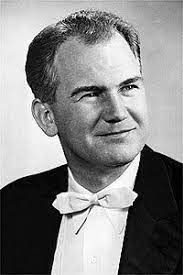 Driving a bright red sporty car, a New Yorker arrived at Oklahoma Baptist University in 1936 to become at the time the youngest college dean in America. In 1977, wearing a bright red jogging suit, he leaped onto the chancel in B.B. McKinney Chapel at Oklahoma’s Falls Creek Baptist Assembly. It was there I first experienced Warren Matthewson Angell, a whirlwind of a conductor, composer, and educator. Disregarding an age requirement, at age eleven I had sneaked into the chapel to sing in the Falls Creek Choir, not knowing my subversive act would introduce me to someone who would forever influence my life and work. I eagerly returned each summer to learn from him. With effective teaching, inspiring words and expressive conducting, he revealed to me the power and beauty of the choral music experience. He had been instrumental in developing the concepts and curricula for music ministry among Baptists, and I knew in those summers before college that I wanted to attend his college of fine arts. 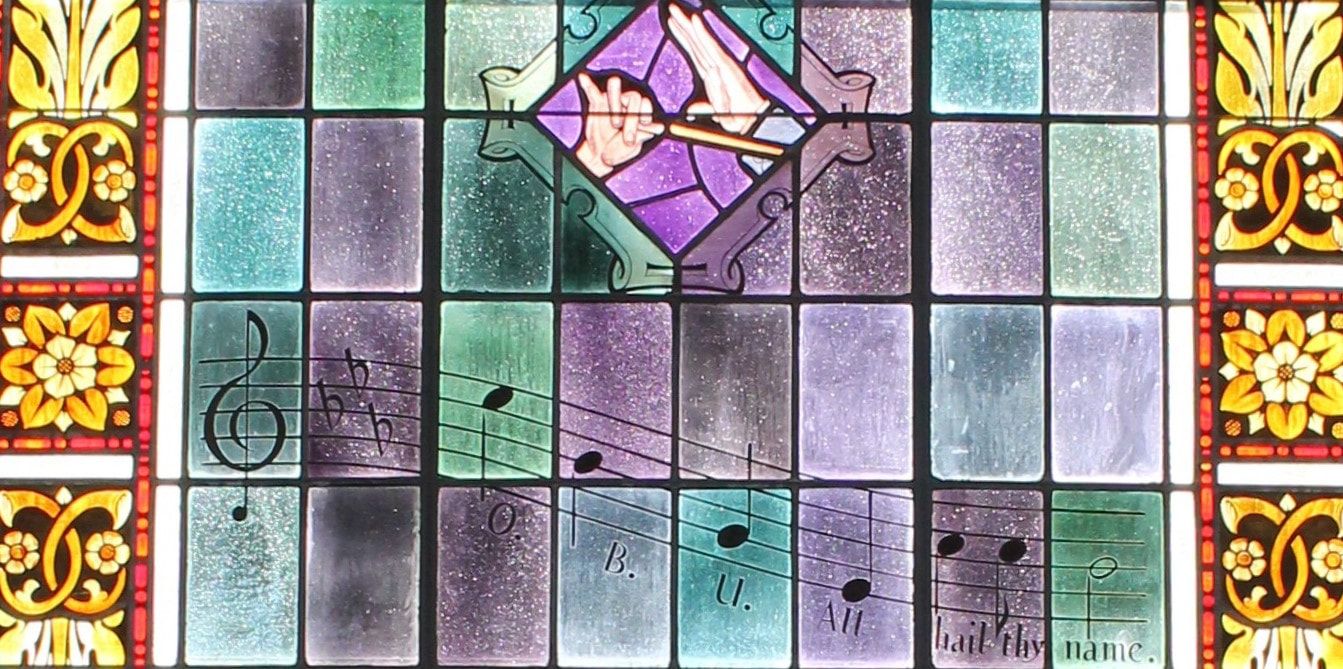 Warren Angell's conducting hands from the chapel window in Ford Music Hall, Oklahoma Baptist University, including a fragment from the tune he composed for the school's "Song to Alma Mater." Though retired by the time I arrived at his namesake, “Warren M. Angell College of Fine Arts" at OBU, I was overjoyed during those years to develop a relationship with "Dean" Angell (as he was called even past retirement). In college I sang in the university's Bison Glee Club he founded, and was selected by him to sing in the Club's "Fallen Angells" Quartet which rehearsed in his home. I gleaned from his work by attending local choral workshops he led, and reveled in his storytelling during several dinner opportunities together. During a Bison Glee Club alumni tour to Hawaii, I was fortunate to be his roommate, providing an extended opportunity to pick his brain on all things church music. He attended my senior composition recital, and while in seminary, I was delighted to attend the university's celebration of his 50th year since arriving at OBU. When serving as a Minister of Music in South Carolina, I was thrilled to host him in concert and worship at two churches and visit him in his Black Mountain, North Carolina, home. Through the years we corresponded through postal mail where he continued to offer his advice and encouragement.  As a music theory and composition major I was keenly interested in Dean Angell's compositions, and we had discussions on the compositional process. He was a prolific composer and arranger of choral, congregational and keyboard music, and was known to dedicate some of his works to friends and students. In 1999, preparing to depart Greenwood, South Carolina, after visiting my family for what would be the last time, he said to me: "If there's anything I can ever do for you...." and, leaving his statement open-ended, I responded: "Just 16 bars!” Though the conversation went no further, he knew exactly what I meant, and several days later I received in the mail a composition for piano! The title was also the dedication:"16 Bars for Larry, Cindy, Kelly & Ryan." In addition to all I had learned and received from him since I was eleven, I was filled with gratitude that the 92-year-old composer had granted my wish! The piano piece (exactly 16 bars) is "classic Angell" in its melodic and harmonic expression. Knowing a bit about his creative process, it seems he conceived the rhythmic motion of the melody by mimicking the two-syllable names of each person in my family. Ever the educator, the final chord of the composition is indicated on the score by him as a "chime,” calling attention to the keyboard properties and harmonic structure he used to produce that particular effect. At the end of the hand-written manuscript dated 9-11-99, is a personal message, revealing the Dean’s characteristic sense of humor. The composition’s tempo marking includes the added instruction: “with feeling” - indicative of how Warren Angell approached music and life. 16 Bars for Larry, Cindy, Kelly & Ryan Piano Composition by Warren Angell Music © 1999 Warren M. Angell. Recording:
16 Bars for Larry, Cindy, Kelly & Ryan Composed by Warren Angell Performed by Larry E. Schultz Many individuals, including myself, consider Warren Angell a mentor. His legacy continues in ministers of music, church musicians, educators, choral conductors, composers, and in persons in professions other than music. I'm thankful for his long and productive life (1907-2006) that brought instruction and inspiration to many! In 2012, a text by my collaborator, Jann Aldredge-Clanton, seemed especially appropriate for me to compose as a choral anthem in memory of Dean Angell. Gathered Here to Share Our Music celebrates diverse humanity and the power of music that Warren Angell knew could transform the world. An Interview of Warren Angell Produced in 1987 by the Radio and Television Commission of the Southern Baptist Convention In response to the news that my influential high school music teacher. Jerry Burdick, passed on May 8, 2023, I offer these memories in tribute. First Meeting... I first met Mr. Burdick in seventh grade when he came to Tulsa’s Clinton Junior High School and sat down beside me at the electric piano I was to play as a new member of the school’s jazz band. Never having played in a rhythm section before, I listened as Mr. Burdick patiently explained to me what it was to “comp” at the piano keyboard. The seeds of creativity he planted in that initial lesson would provide me with a love of playing in jazz bands through college and would later blossom to influence my work as a composer. Learning from a Skilled Educator... I entered Mr. Burdick’s marching band at Daniel Webster High School with several of my friends in ninth grade. Though our freshmen class was still housed at Clinton Junior High, we’d walk over to Webster on beautiful fall or cold winter mornings to learn from this master teacher. Throughout my high school experience in his marching, concert and jazz bands, Mr. Burdick exemplified the best in education and musicianship. It was his clear conducting technique I mimicked in my teenage church music jobs and upon entering Oklahoma Baptist University as a music major. Many Valuable Lessons... Not only did I learn to comp at the piano, effectively play my trumpet, and conduct from Mr. Burdick, but by example he taught unparalleled organizational skills, and what it meant to be an upstanding and caring citizen in the community. As an active and long-time church musician, his life of faith and concern for all people was evident. I also learned to value “quality over quantity” from Mr. Burdick. Though our high school marching band was the smallest in the city of Tulsa, it didn’t keep us from winning a city-wide marching band competition in spite of the twelve other bands that were two and three times our size. We won because Mr. Burdick inspired us individually and collectively to give our best, and we also won because of his forward-thinking creativity. Our show wowed the judges with rotating square formations and other new marching techniques of drum and bugle corps that had not yet spread throughout high school bands. This win was especially meaningful that year as, due to low enrollment, the possible closing of our high school was threatened. After the win a billboard proudly proclaimed our success to the entire city and in my estimation helped to keep our school open. Quality over quantity had prevailed and provided a valuable lesson for my work in church ministry. Expanding Musical Horizons... Mr. Burdick expanded my musical horizons in many ways, contributing to my work as a Minister of Music, composer, hymn writer and teacher. In the churches of my childhood, I mostly experienced the music of American gospel hymns, but in high school concert band, Mr. Burdick exposed my mind and ears to gifted composers from around the world including England’s Ralph Vaughan Williams and Gustav Holst. In high school I was so enthused by playing the band transcription of Holst’s The Planets, that I engaged in an individual study on Holst in college. This study was important to my theory and composition degree at Oklahoma Baptist University, and I was deeply honored when Mr. and Mrs. Burdick drove miles to attend my senior composition recital at OBU. A Grateful Opportunity... One often loses touch with high school teachers after graduation, but after graduating seminary and entering full-time music ministry, I was commissioned by my friends, the Burdick children, to write a composition for their father as a surprise to celebrate his 60th birthday and 30 years as Director of Music for Epworth United Methodist Church, Tulsa. I tried to “pull out all of the stops” for Mr. Burdick, demonstrating in the composition both the joy and skills of music-making he had instilled in me. I think of him each time I conduct a choir in singing the resulting psalm setting, Play Skillfully and Shout with Joy! An Amazing Story... Though I would hear about Mr. and Mrs. Burdick through the years from their children or other West Tulsans, I did eventually lose touch with their whereabouts. And my life’s work had taken me and my family to Raleigh, North Carolina. But eventually, I experienced an unbelievable reconnection… My mother and father-in-law were exploring assisted living communities in the Charlotte, NC, area. One weekend my wife and I traveled to Charlotte to help with their search. While taking a tour of a facility, I noticed a piano, and commented that my mother-in-law was a fine pianist and would enjoy playing. The employee giving us the tour then said to me: “We also have a wonderful gentleman who comes once-a-week to play for the residents…His name is Jerry Burdick.” At that instant I let out the loudest “WHAT!!!” one can imagine! I then said: “Jerry Burdick is my beloved high school music teacher from Oklahoma!” The employee did not have to give his name, but I’m glad she did (along with his phone number)! The Burdicks were now in North Carolina! Immediately upon arriving back home I called the Burdicks to catch up and tell them this amazing story. And there’s more… In 2018 I had the opportunity to compose We Are a People on a Journey for the 75th Anniversary of Myers Park Baptist Church in Charlotte. In January of that year, I would get to attend worship there for the premiere of the hymn. This provided the wonderful opportunity to see my influential high school teacher and his wife, as I spent time that weekend with Jerry and Phyllis in their beautiful home. But the best part was that the Burdicks accepted my invitation to join me at Myers Park for the premiere! This was truly a full-circle moment. As the church’s pianist improvised on my tune for the prelude that morning, I was transported back to seventh grade when Mr. Burdick taught me to improvise. As the brass quintet, timpani and pipe organ played the introduction to my hymn, I remembered how my musical horizons were expanded in Mr. Burdick’s band to be able to envision and compose such sounds. And as the choir and congregation sang, I gave gratitude for the influence and presence of the Burdicks on this special day. Deep Gratitude... I am not the only student shaped and inspired by Jerry Burdick. I join countless others in giving thanks for his life and meaningful work that continues to thrive in us all. 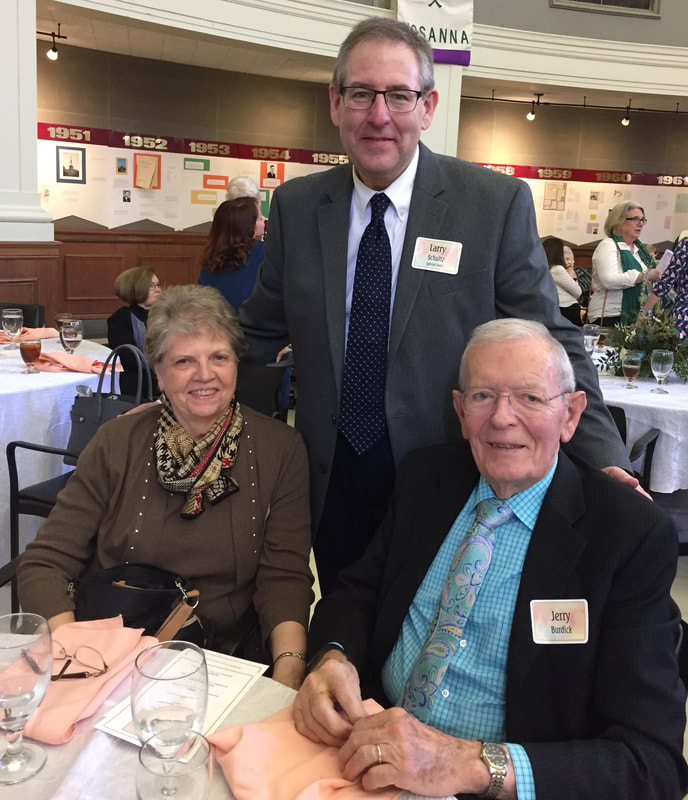 Phyllis Burdick, Larry E. Schultz & Jerry Burdick at Myers Park Baptist Church, Charlotte, North Carolina. January 21, 2018.
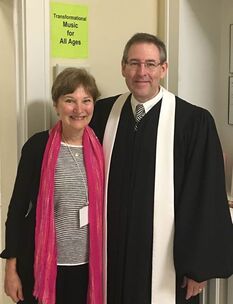 Years after being influenced and inspired by the work of hymn poet, Brian Wren (see previous blog post), I met Jann Aldredge-Clanton with whom I enjoyed a 23-year collaboration. Jann was a minister, author, English professor, lyricist, hymn poet, hospital chaplain and feminist theologian (quite qualified to write effective and prophetic words for the church!). In the spring of 2001, I heard Jann offer the Covenant Address for the Alliance of Baptists Convocation. She powerfully encouraged congregations to discover and reclaim images of the Divine Feminine – and to sing them in worship. She underscored the biblical foundations and the many reasons to sing of God as “She” and “Her” – not the least of which was to liberate all from oppressive patriarchy and to exclaim the truth that females are in the Divine Image. Several months after hearing Jann’s address, I became Minister of Music for Pullen Memorial Baptist Church, Raleigh, NC. With her words still ringing in my ears and a congregation eager to sing of the Divine Feminine, I reached out to introduce myself to Jann. Revealing I was a composer, I asked if she had any texts I could set to music. On September 11, 2001 (a morning that was met with unspeakable tragedy), I discovered an email from Jann that included a hymn text for me to set. The text she sent, “Are You Good and Are You Strong?” was a theodicy (questioning the presence of goodness in midst of evil). The words were unbelievably timely and cathartic for the particular day on which I received them. Our 23-year creative partnership resulted in a musical, curriculum, anthems, 6 song collections, and 450 hymns. Though I have provided new tunes and arrangements for many of Jann’s hymns, I have typeset all of them for our collections, and in doing so, have been a student of her ministry. On September 20, 2024, days after completing our sixth song collection, Jann died of ovarian cancer. Healing Streams: Inclusive Songs, Prayers, and Readings for All Ages, is now published and available to the world. Because Jann's prolific work has left a treasury of lyrics yet to be musically set, our creative work will continue. Jann will continue to speak through the vibrant voices of congregations and choirs. Works by Jann Aldredge-Clanton & Larry E. Schultz Feminist theology, like other specific theologies, intersects with many areas of thought, study, concern, and celebration. The works Jann and I have created together support these areas and engage justices of all kinds – from gender and racial to economic and ecological. With ever-evolving language, we seek to provide words and music for worship that uplift all persons of innumerable and wonderful descriptions. |
AuthorLarry E. Schultz is a Minister of Music, Composer, Hymn Writer, and Music Teacher. Archives
August 2026
Categories
All
|


 RSS Feed