
LARRY E. SCHULTZ
  • Congregational Music
    • Downloadable Congregational Music >
      • Hymns
      • Songs
      • Collections
    • Published Congregational Music
    • Downloadable Hymn Enhancements
  • Choral Music
    • Downloadable Choral Music (Church) >
      • Anthems >
        • Unison, Two-Part & Mixed
        • SATB
      • Service Music
      • Hymn Enhancements
    • Published Choral Music (Church)
    • Downloadable Choral Music (School & Community) >
      • Unison, Two-Part & Mixed
      • SATB
    • Published Choral Music (School & Community)
    • Downloadable Vocal Exercises
  • Instrumental Music
    • Downloadable Instrumental Music (Church) >
      • Digital Recordings
      • Hymn Accompaniments
      • Hymn Obbligatos
    • Downloadable Instrumental Music (School & Community)
  • Vocal Solos/Duets
  • Music Instruction
    • Piano Lessons
    • Voice Lessons
    • Composition Lessons
    • Music Theory Instruction
    • Sight-Singing/Ear Training
    • Student Page
  • Resonate! (Blog)
  • About Larry
    • Minister
    • Composer
    • Hymn Writer
    • Teacher
    • Commissions, Awards & Collaborators
    • Music Typesetting
Picture
a Blog related to
​Communal Music

Lessons Learned as a Baptist Separatist

6/21/2023

 
Before I knew it was one of the most historic and identifying characteristics of Baptists, my parents taught me what it meant to be a Separatist.

In the mid-1970’s my family separated from our local Baptist church after it was strategically overtaken and controlled by a large group of new members who enforced outlandish theologies and unreasonable practices. This separation was not done lightly nor without grief as my parents had invested 30 years of their lives in this congregation. They made the decision to move from Tulsa’s Phoenix Avenue Baptist Church, to nearby Red Fork Baptist Church, in order to provide a positive experience for me as I entered junior high school. This change impacted my life for the better and demonstrated there would be occasions when being a Separatist was the best choice. As I grew and prepared for ministry, this understanding continued to guide my church and denominational life.

The Southern Baptist Convention taught me what it meant to be Fundamentalist.

In the 1980’s the SBC (a denomination whose history includes the endorsement of slavery) shamefully pronounced the inequality of women, the depravity of homosexuals and a disregard for Biblical scholarship. During this time, I was receiving excellent training for music ministry at Oklahoma Baptist University where I experienced the exact opposite: gifted women who were professors and church ministers, upstanding gay friends, and a responsible, thoughtful approach to the Bible. While continuing my education at The Southern Baptist Theological Seminary, I witnessed the Convention’s fundamentalist takeover that resulted in hurtful actions bombarded upon professors and students. In response, I wrote a hymn in 1988 that was published in The Baptist Hymnal, 1991: “O God, We Ask for Strength.” At best, the hymn was my protest; naively, I thought the SBC might sing its words and repent. But it didn’t work, and I became a Separatist again, not wanting to be associated with a denominational group that weaponized the Bible to harm and abuse others.

The national Cooperative Baptist Fellowship taught me what it meant to be Moderate.

In the year 2000, the national CBF Coordinating Council voted to affirm policies that would communicate a position of being “Welcoming but Not Affirming” of LGBTQIA+ people. (If that’s not a moderate stance, I don’ t know what is.) At the time I was the youngest member of the national CBF Coordinating Council, and after standing with those who opposed this position, I immediately resigned from the council, becoming a Separatist once again. Having lived through the exclusionary trauma of the SBC, and after giving much time and energy to both state and national CBF bodies, I was physically sick to experience the national CBF’s acts of oppression. (Because of Baptist polity I make a distinction between the actions of the “national” and “state” CBF organizations, as each body is autonomous). It was not lost to me that the CBF, an organization whose membership was comprised of outcasts from the SBC, was now continuing the same cycle of exclusion. I knew that some members would remain in an effort to bring about change from within, but I also knew that individual and institutional advancement would take time. After personally witnessing the deeply injurious actions of the SBC, I didn’t want to spend my time in ministry trying to convince another ecclesiastical organization that it should be inclusive. I simply did not have the patience or desire.

The Alliance of Baptists, my church congregation and others are teaching me what it means to be Liberal and “beyond.”

During my seminary years I heard about the formation of the Alliance of Baptists, and the first two churches I served were minimally associated with this fledgling Baptist network. After my resignation from CBF, I became much more involved in the Alliance and read in its newsletter about the search for a Minister of Music at Pullen Memorial Baptist Church, Raleigh, NC (which I became in 2001). I had previously learned about Pullen through national news articles that revealed the church’s commitment to fully include LGBTQUIA+ people. Because of this stance, in 1992 the SBC ousted Pullen from its membership, but a supportive community was already in place as five years earlier members of Pullen joined others in forming the Alliance. After becoming Pullen’s Minister of Music, I learned that the church never connected to the moderate CBF because it suspected from the beginning that the CBF would not be as open and inclusive as the Alliance. From my experience, this prediction was accurate.

While no congregation or denominational organization is perfect, the liberalism expressed through Pullen and the Alliance of Baptists resonates with me and seems to have put an end to my Separatist ways. A liberalism that continues to progress encourages life-long learning, the willingness to venture out, and the equal willingness to change course as new wisdom emerges. Compared to the mental restraints of fundamentalism, progressive liberalism allows the freedom of inquiry essential for this post-theistic century. But liberalism also has limits. There are times when liberalism is inadequate and invites the search for what is “beyond."

Perhaps even more descriptive for me than the term, “Liberal,” are words I suggested for a sanctuary art installation at Pullen: “Ever Embracing” and “Ever Becoming.” These active phrases express how I desire to be identified – “Ever Embracing,” as I participate with my church and other groups in welcoming and including all, and “Ever Becoming” as I evolve, explore new insights, and discover who continues to be excluded.

Interestingly, it is by being a Separatist that I have been able in good conscience to remain both Christian and Baptist – two worlds in which I was born, have grown, was educated, and continue to offer my ministry of music.

Songs Born Out of
​My Separatist Journey:

  • ​O God, We Ask for Strength - a hymn text written during the fundamentalist takeover of the SBC, promoting peace,  proclaiming individual freedom, and encouraging cooperation. Included in The Baptist Hymnal, 1991.
  • Let Us Rejoice and Sing! - an anthem for voices and piano originally written for an early organizational gathering of the South Carolina CBF with a middle section inviting continued hope during difficult days. Published by Choristers Guild.
  • ​A Living Celebration of Christ's Love - a hymn text and tune written during my time in CBF, expressing the functions of the church and emphasizing worship, responsible scholarship, the embracing of all people and ministry. Composed for First Baptist Church, Greenwood, SC.
  • From Wisdom Emerging - a hymn text based on a Covenant of the Alliance of Baptists, and winner of the Alliance's 25th Anniversary Hymn Search. The arranged tune includes a trumpet obbligato. Published by the Hymn Society in "Singing Welcome" and its forthcoming Centennial Collection.
  • We Are a People on a Journey - a hymn text and tune with choral descant commissioned for Alliance congregation, Myers Park Baptist Church, highlighting openness, diversity, reasoned faith, ministry and celebration. Published by Eakin Press in the collection, "Inclusive Songs for Resistance and Social Action." 
  • ​Ever Embracing, Ever Becoming - a hymn text and tune with a choral coda written for Alliance congregation, Pullen Memorial Baptist Church, expressing continuous welcome and evolution.
Picture
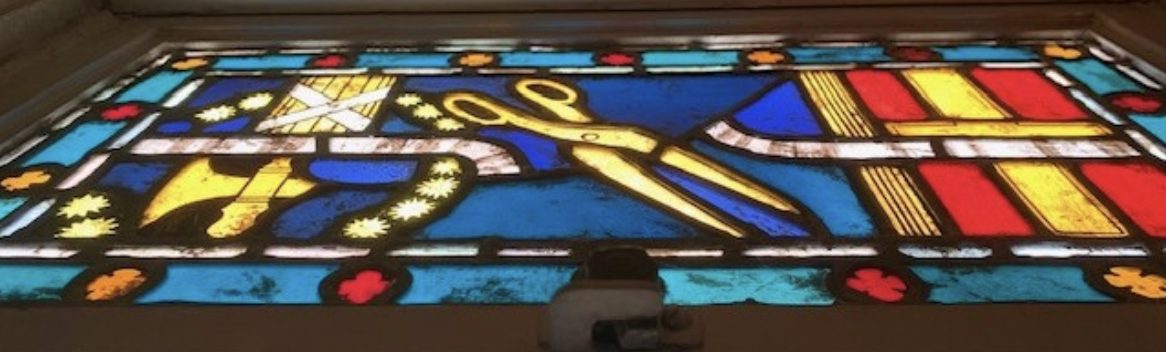
One aspect of Baptist separatism is depicted in a pane of the Roger Williams window at Pullen Memorial Baptist Church, Raleigh, NC. This pane expresses the Separation of Church and State by displaying emblems of State Power (Roman judicial ax) and Christian Faith (cross) disconnected with scissors.

A Journey Toward Oneness

1/30/2020

 
​I’m grateful to live and work among people that respect religious plurality and to be minister of music for a congregation that celebrates it![1] This is a different experience from my upbringing in Southern Baptist churches that, except for the occasional Thanksgiving community service, did not emphasize ecumenism and certainly did not encourage the support of other religions. In high school, I remember studying a denominational pamphlet that denied the validity of other faiths by providing scriptural defense for Christianity as the only true religion. My eyes were opened to this kind of isolationism when my Western Civilization professor at Oklahoma Baptist University bravely exposed the egotism involved in Southern Baptists’ “Bold Mission Thrust,” a campaign in the last quarter of the 20th century to evangelize the world without cooperative work with other denominations. Though I appreciate and value many aspects of my early church experience, it did not teach that Christianity, nor even its various denominations, could “coexist” as the contemporary art piece and bumper sticker expresses.

This insecurity of the Christian religion was demonstrated further in several ways during my youth. In church youth group, I remember seeing horrific movies that graphically warned of apocalyptic “anti-Christs” and “marks of the Beast,”[2] and singing popular “Christian” songs, such as “I Wish We’d All Been Ready,”[3] or “Oh Buddha,”[4] that sought to scare “the hell” out of us. All of these promoted a strict Christianity-only message as they traumatized us to think that we would be “left behind” and sent to a fiery pit if we didn’t believe in Jesus as the only way. Even more, one had to have the right kind of Christian experience in order to get to heaven. A revival evangelist at my church once shamefully exclaimed that many of our Christian experiences were “counterfeit,” causing my adolescent emotions to go wild and my teenage mind to fear.

Thankfully, the guidance of my parents and the wisdom they provided navigated these disgraceful and potentially harmful church experiences, allowing me to healthfully continue exploring faith while asking questions along the way. Through continued education I came to understand that Christianity is only one of countless other faith expressions (and that Christianity itself is interpreted and practiced in unbelievably diverse and conflicting ways). I came to know that some persons of faith – Christian or otherwise – rely on a divine being or beings while others live deeply meaningful lives apart from belief in any Gods. And those that do express confidence in a supreme being or beings, understand and name those divinities in myriad ways.

People in our country and all over the world express their best humanity and highest values in ways worthy of honor. Some express them through religion and others do not. The Jesus I grew to envision would have no problem with this, and even more, would call diverse peoples to recognize similarities and celebrate differences while working together to create a loving and just world. If the world’s peoples could ever achieve peace, the Jesus I imagine would not mind if his name was a part of that result or not. I think this is what Episcopal bishop, John Shelby Spong, means (as referenced in my first blog post) when he encourages us to walk so deeply through our own tradition and into our humanity that tribal boundaries disappear.[5] And I think this is what minister, Gretta Vosper, of the brave West Hill United Church, Toronto, Canada, means when she exclaims “the way we live is more important than what we believe.”[6]
​
As ever-evolving 21st century people, while living our most authentic selves, can we transcend our own limited experience, find relevance in our work and become one with all? ​I think we must.

(One of my congregational songs that supports religious plurality is Where Is the Sacred?)

[1] ​Pullen Memorial Baptist Church’s 125th Anniversary hymn, “In Our Own Voice (Raise Up New Hope)” by Shirley Erena Murray & Larry E. Schultz describes the congregation as one that sees “in other faiths enduring worth.” The hymn is published in Murray’s collection: A Place at the Table (Hope Publishing Company, 2013).

[2] A Thief in the Night film series written by Russell S. Doughten, Jr., Jim Grant, Donald W. Thompson.

[3] Song by Larry Norman, recorded by various artists and included in the A Thief in the Night film series as well as the more recent Left Behind movie.

[4] Song by Mark Farrow recorded by The Imperials on the album: Heed the Call (DaySpring Records, 1979).

[5] See A New Christianity for a New World: Why Traditional Faith is Dying & How a New Faith Is Being Born (HarperCollins Publishers, 2001) and other books, essays and lectures by John Shelby Spong.

[6] From the subtitle and content in Gretta Vosper’s book, With or Without God: Why the Way We Live Is More Important than What We Believe (HarperCollins Publishers, 2008).

    Author

    Larry E. Schultz is a Minister of Music, Composer, Hymn Writer, and Music Teacher.

    Archives

    July 2025
    June 2025
    April 2025
    July 2023
    June 2023
    May 2023
    April 2023
    March 2023
    July 2021
    January 2020
    August 2019

    Categories

    All
    Anthems
    Baptism
    Children's Choirs
    Choral Music
    Collaboration
    Communion
    Community Choirs
    Congregational Song
    Education
    Hymns
    Indeterminate Music
    Interfaith
    Middle School Choirs
    Music Ministry
    Music Notation
    Philosophy
    Piano Music
    Pluralism
    Religion
    School
    Science
    Technology
    Theology
    Tribute
    Worship

    RSS Feed

Copyright 2025 Larry E. Schultz. All rights reserved.
  • Congregational Music
    • Downloadable Congregational Music >
      • Hymns
      • Songs
      • Collections
    • Published Congregational Music
    • Downloadable Hymn Enhancements
  • Choral Music
    • Downloadable Choral Music (Church) >
      • Anthems >
        • Unison, Two-Part & Mixed
        • SATB
      • Service Music
      • Hymn Enhancements
    • Published Choral Music (Church)
    • Downloadable Choral Music (School & Community) >
      • Unison, Two-Part & Mixed
      • SATB
    • Published Choral Music (School & Community)
    • Downloadable Vocal Exercises
  • Instrumental Music
    • Downloadable Instrumental Music (Church) >
      • Digital Recordings
      • Hymn Accompaniments
      • Hymn Obbligatos
    • Downloadable Instrumental Music (School & Community)
  • Vocal Solos/Duets
  • Music Instruction
    • Piano Lessons
    • Voice Lessons
    • Composition Lessons
    • Music Theory Instruction
    • Sight-Singing/Ear Training
    • Student Page
  • Resonate! (Blog)
  • About Larry
    • Minister
    • Composer
    • Hymn Writer
    • Teacher
    • Commissions, Awards & Collaborators
    • Music Typesetting